Motorcar Monday
From Rumble Seats to Dashboards: What's gone and what remains

This marks the inaugural Motorcar Monday; this feature reappears the second Monday each month. Why include a sketch about cars? For one, I always describe vehicles in my books, since that helps to illustrate the differences between “then and now.” It also gives depth to the historical setting. And I love cars!
During the Prohibition Era, Americans hit the roads in motorcars in greater and greater numbers. In 1920, over 8 million vehicles were on the road. By 1929, the number had increased to 23 million. Today, almost 300 million are registered.
While Americans were driving more during the Roaring Twenties, the number of car manufacturers declined. Vehicle production involved hundreds of companies in the 1910s. Fewer than one hundred existed by the late 1920s. At that point, the Big Three (Ford, Chrysler, and GM) produced about 80% of automobiles. Today, they hold a 38% share. (Note: Chrysler no longer exists. Most of its models are produced by Stellantis.)
As you may know, General Motors merged multiple makes. The company was founded by William Durant in 1908. His vision was to produce a “car for every purpose and pocketbook.” It isn’t a stretch to say he succeeded. Even today, GM manufactures a wide range of vehicles. Over the years, I’ve driven a few of them! I’ll have photos of some as the months go.
Growing up in the Toledo area, I’ve been exposed to car culture all my life. In addition, one of my dad’s best friends was the general manager for a Chevrolet dealer. One of the highlights of my young life was going to the dealership with my father. While he and John visited, I got to sit in the conference room with a selection of model cars. It was Seventh Heaven to “race” them the length of the table. A bonus was taking one home with me. Later, another of my dad’s dear friends became a dealer. I still think of all three when I go car shopping, and I still get a thrill when I walk into a showroom. The little girl who dreamed about driving has been a woman driver for decades, but there is nothing quite like browsing beautiful vehicles.
Today, cars are designed for practicality and desirability. In 1920, manufacturers often focused on comfort, convenience, and technological upgrades. For decades, drivers have had the “luxury” of key or electric start, but that was not always true. In the beginning, most vehicles had crank starters. Not only did this take strength and time, it could be dangerous if the driver released the crank but got in the way. As a young woman, my paternal grandmother suffered a broken arm from such an accident. That story was often repeated, much to her dismay.
Another feature that most of us take for granted is climate control. Old-time cars did not have heaters, let alone air-conditioning. For years, many were open to the elements. Even after closed carriages became the norm, window-glass was not standard. For a time, curtains were used. Then, an upgrade to Isinglass took place. If you’ve heard the soundtrack from Oklahoma, you know the line: “With Isinglass windows you can roll right down in case there’s a change in the weather.” Thinking about driving in the dead of winter without heat or glass windows sends a chill through me! Isinglass is still manufactured, although differently than in the early Twentieth Century. Today, the term is used to describe thin, clear sheets of PVC. The material is often used on boats and sometimes, in porch enclosures.
Because vintage cars were not climate-controlled, blankets were a standard addition to the supplies. Another important accessory was driving gloves, to protect one’s hands from cold and dirt. When there were no glass windshields and few paved roads, getting soiled was a hazard. Contemporary vehicles still have a compartment referred to as the “glove box,” but I don’t know anyone who keeps a pair of gloves there. Mine has the owner’s manual.
Even though car makers now say “electronic panel” for the area with gauges and controls, most people still call it the “dashboard.” That term predates automobiles. Originally, it was a wooden or leather barrier connected to the front of a carriage or a wagon pulled by horses. This block was to protect the driver from dirt and debris “dashed up” by hooves. We don’t need to go into details about what have been stirred up.
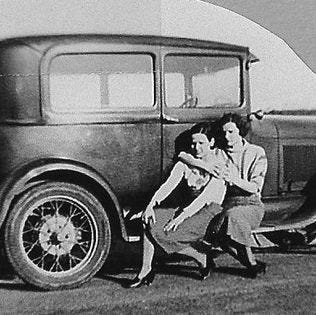
Other vintage features besides hand cranks have also disappeared. Running boards, which were a necessity when car tires were tall and people needed a step up, went away in the late 1930s. Today, they are seen on trucks and vans; they serve the same as in bygone days. Rumble seats, pop-up seating for extra passengers, vanished around the same time. As you might guess, these seats were not only uncomfortable, they could be dangerous in a collision.
If you’re headed out in your own car today, safe travels! And take a moment to enjoy all the wonderful features that we would not have had a hundred years ago.
Next month, Motorcar Monday will look at Jeep, born in Toledo. Next Monday, watch for Bootlegger Briefs. Also, coming soon, this quarter’s “From the Author’s Desk,” which is quite cluttered right now.
Photo courtesy of my dad.
!